
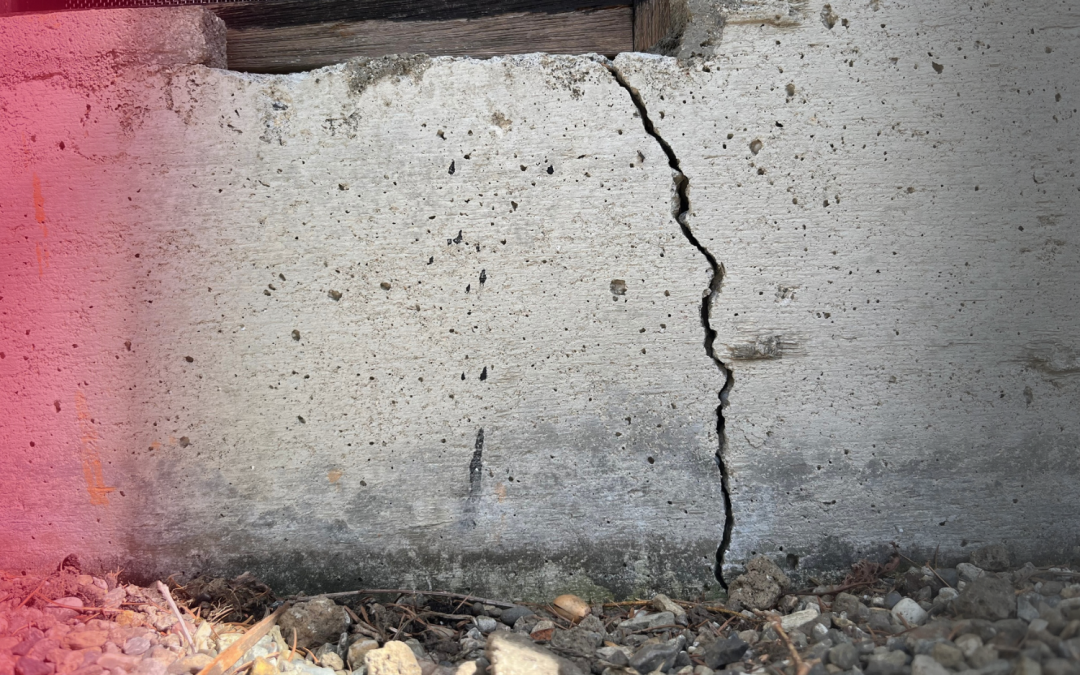
You spot a crack in the foundation wall. Maybe it is as thin as a pencil line. Maybe it is wider and runs at an angle. Either way, your first reaction is probably a mix of worry and confusion.
Here is the short answer: not every crack in a foundation wall is a crisis. But every crack deserves a trained set of eyes. The difference between a normal settling crack and a dangerous structural problem is not always something you can judge by looking at it for 30 seconds.
So, how do professional inspectors actually tell them apart? In this post, we walk you through exactly what a trained inspector looks for, why the process matters, and what you should do if you find a crack in your home.
Why a Crack in the Foundation Wall Is Not Always What It Seems
Many foundation cracks are cosmetic and form naturally as a house settles. But some signal serious structural problems. The only way to know the difference is through a proper inspection.
Concrete moves. Soil shifts. Temperatures rise and fall. Over time, these forces act on your home’s foundation constantly. Because of this, cracks are incredibly common.
In fact, foundation cracks affect more than 6 million American homes nationwide, making them one of the most frequently reported structural concerns among homeowners.
But here is the key thing to understand: a crack forming does not automatically mean your home is in danger. Some cracks are purely cosmetic, the result of concrete shrinking as it cures during the first few years after construction.
Others, however, point to soil movement, water pressure, or structural stress that needs attention sooner rather than later.
The problem is that both types of cracks can look very similar to the untrained eye. That is precisely why a professional home inspector brings far more to the table than a quick visual check ever could.
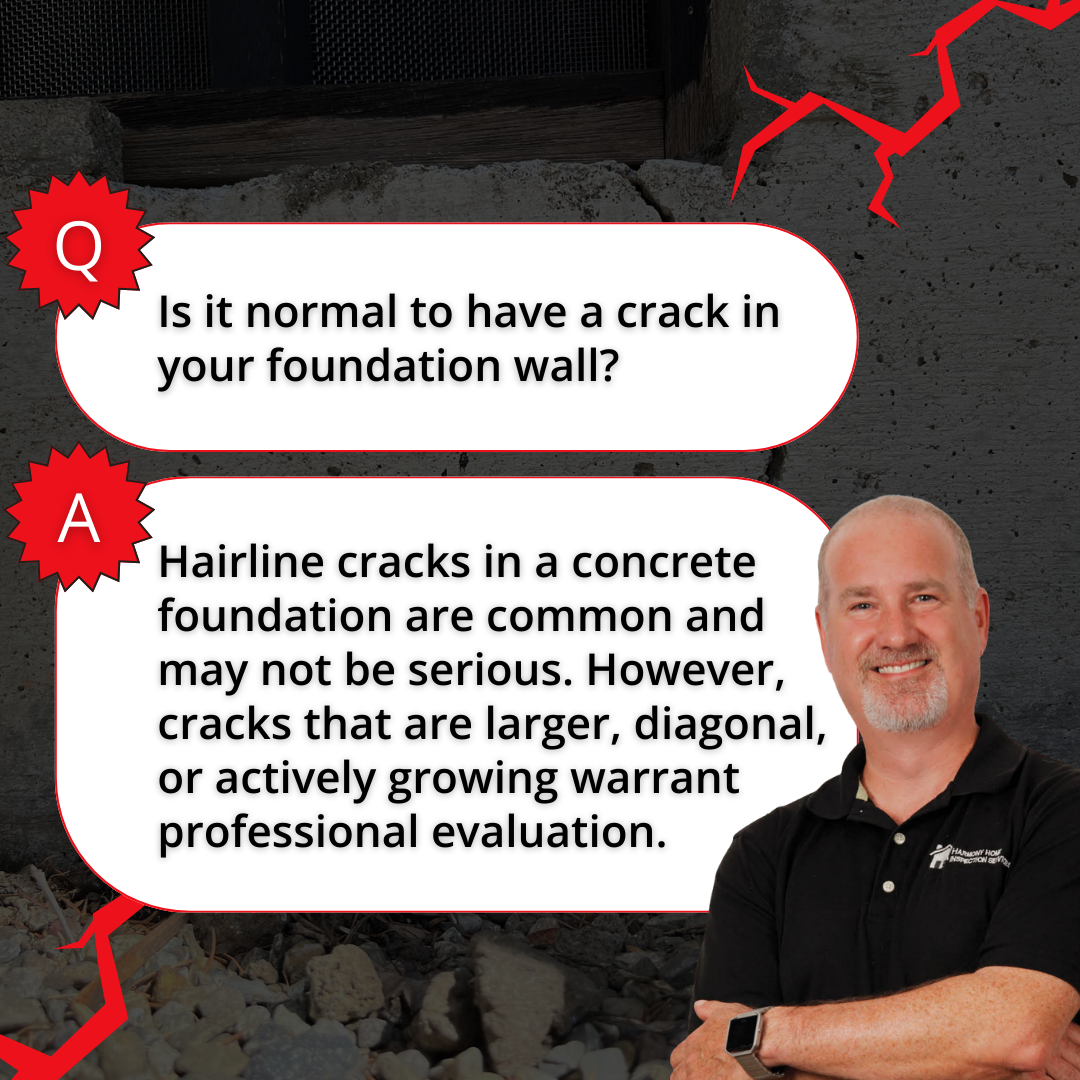
What Makes Foundation Cracks So Easy to Misread?
Homeowners tend to focus on what they can see directly in front of them.
However, what makes a crack dangerous usually lives beneath the surface. Inspectors look at the whole picture, including soil conditions, moisture levels, and structural patterns that connect one part of the home to another. Without that full picture, it is very easy to draw the wrong conclusion.
Can You Assess a Crack in the Foundation Wall Yourself?
You can observe some basic details on your own, but self-assessment almost always misses what matters most. A professional inspection is the only reliable way to evaluate a crack properly.
Homeowners can reasonably notice a few things on their own. For example, you can look at the general width of a crack, check whether it runs vertically or at an angle, and see if you notice any water stains around it.
However, self-assessment breaks down quickly once you move past surface-level observations.
What the DIY Approach Consistently Misses
- Whether the crack is still actively growing or has been stable for years
- Hidden moisture behind or beneath the wall that has not yet become visible
- Whether the crack connects to other structural issues elsewhere in the home
- The soil conditions outside the wall that are driving the crack in the first place
- Subtle bowing or displacement in the wall that the naked eye tends to overlook
One of the most common mistakes homeowners make is assuming a small or hairline crack is harmless simply because it looks minor. In reality, width alone does not determine severity.
A narrow crack that is actively widening, located at a structural corner, or accompanied by moisture, can be far more serious than a wide crack from normal settling.
Furthermore, delaying a professional evaluation based on a surface-level look is where things often go wrong. The longer a problematic crack goes unaddressed, the more expensive the repair tends to become.
When Should You Call an Inspector?
As soon as you notice a crack that is wider than a hairline, shows any sign of moisture, or sits near a corner or structural opening, you should call a professional.
Even if the crack turns out to be minor, the peace of mind alone is worth it. And if it turns out to be serious, catching it early saves you significantly in repair costs down the road.
What Tools Do Inspectors Use to Evaluate Foundation Cracks?
Professional inspectors use specialized tools and formal training to evaluate foundation cracks in ways a homeowner’s walk-through simply cannot replicate.
When a trained inspector evaluates a crack in a foundation wall, they are not just looking at it. They are measuring it, testing the surrounding area for moisture, checking for wall movement, and placing it in the context of the entire home’s structure.
The Tools Inspectors Bring to a Foundation Evaluation:
- Crack width gauges to measure precisely whether a crack exceeds safe thresholds
- Moisture meters to detect water intrusion that has not yet become visible
- Levels and plumb bobs to check whether the wall is bowing or leaning
- Flashlights and inspection mirrors to assess hard-to-reach areas
- Photo documentation to track crack progression and compare it over time
Beyond tools, training plays a huge role. Certifications from organizations like InterNACHI and ASHI require inspectors to understand structural systems, soil behavior, drainage, and how all of these factors interact with one another.
As a result, that combination of tools and training allows an inspector to move past what a crack looks like and evaluate what it actually means for the home.
Why Does Training Matter as Much as Tools?
Because context is everything. Two cracks can look identical and mean completely different things depending on where they appear, what the soil conditions are, and how the rest of the home is behaving. Training teaches inspectors to read all of those signals together rather than in isolation.
The Types of Foundation Wall Cracks and What Each One Means
The shape, direction, and location of a crack in a foundation wall all affect how serious it is. Not all cracks mean the same thing.
Understanding the type of crack you are dealing with is one of the first things an inspector assesses. To make this easier to follow, here is a breakdown of the most common types:
|
Crack Type |
Common Cause |
Severity |
What to Do |
|
Horizontal |
Lateral soil or water pressure |
High |
Call a professional immediately |
|
Vertical |
Normal concrete curing or settling |
Low to Medium |
Monitor; inspect if widening |
|
Diagonal |
Differential settlement |
Medium |
Have an inspector evaluate |
|
Stair-Step |
Settlement in block or brick walls |
Medium to High |
Professional evaluation needed |
|
Hairline |
Concrete shrinkage during curing |
Low |
Monitor over time |
It is also worth noting that width alone does not tell the whole story. Additionally, a crack’s location on the wall carries a lot of weight. A crack near the center of a long wall may behave very differently from one forming in a corner or near a window opening.
Which Crack Type Do Inspectors Find Most Often in Homes?
Diagonal and stair-step cracks show up frequently in North Georgia and Metro Atlanta homes, largely because of the region’s expansive red clay soil.
The Warning Signs That Separate a Dangerous Crack from a Normal One
A dangerous crack in a foundation wall typically shows signs of active movement, water intrusion, bowing, or alignment with other structural problems inside the home.
Not every crack raises the alarm. However, certain warning signs tell an inspector that a crack has moved well beyond normal settling territory. Knowing what those signs are helps you understand what your inspector is looking for and why it matters.
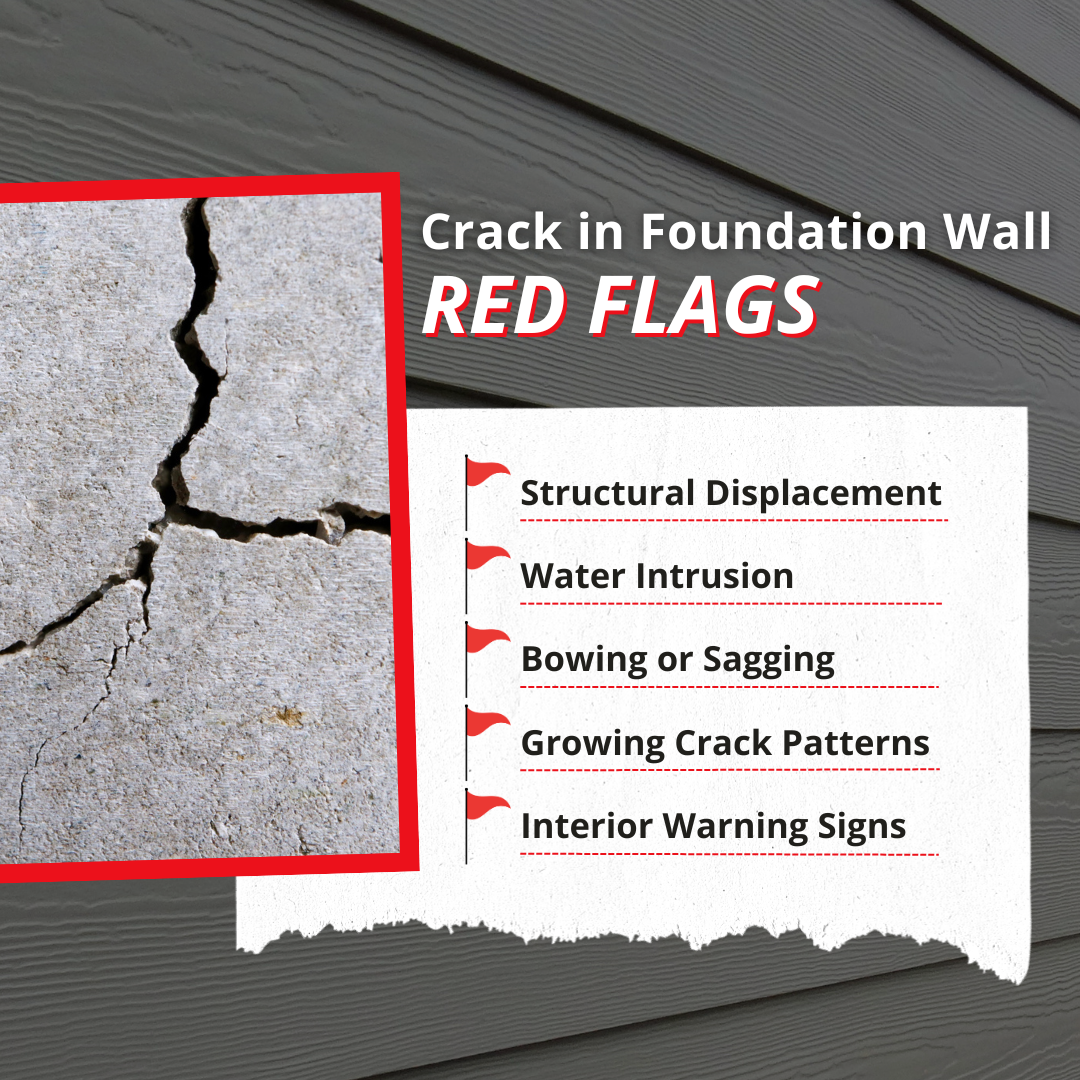
The Red Flags Inspectors Take Seriously:
- Active vs. inactive cracks: Inspectors look for fresh concrete dust, jagged edges, or recent displacement that signals the crack is still growing.
- Water intrusion: Moisture alongside a crack increases both the structural risk and the likelihood of mold growth behind the wall.
- Bowing or displacement: When one side of the crack sits higher or farther forward than the other, the wall is actively under stress.
- Converging crack patterns: Multiple cracks forming a pattern, especially near corners or mid-wall, signal more widespread movement beneath the surface.
- Interior warning signs: Doors that stick, floors that feel uneven, and drywall cracks near doorframes often mirror what is happening in the foundation below.
What Georgia Soil and Climate Do to Your Foundation Over Time
Georgia’s red clay soil expands when wet and contracts when dry, which puts constant pressure on foundation walls and makes cracking more likely than in many other parts of the country.
If you live in Metro Atlanta or North Georgia, your foundation faces a challenge that many homeowners across the country simply do not deal with at the same level: expansive clay soil.
According to the American Society of Civil Engineers, 25% of all homes in the United States experience some form of damage tied to expansive soils.
In Georgia, that number reflects a real and ongoing pattern that inspectors in this region see regularly.
How Georgia’s Climate Makes the Problem Worse
Georgia’s red clay absorbs moisture and swells during wet seasons. Then, during the hot and dry summers the region is known for, that same soil contracts and pulls away from the foundation.
This seasonal push-and-pull creates constant movement beneath and around your home’s foundation walls.
Counties like Cherokee, Forsyth, Hall, and Gwinnett all sit on soil profiles that amplify this cycle. Because of this, homeowners in these areas often discover that a crack they first noticed in the spring has widened by fall, even without any obvious weather event in between.
What Else Speeds Up Foundation Cracking in Georgia?
Beyond soil, drainage, and grading play a critical supporting role. When gutters overflow, downspouts discharge water near the home, or the yard slopes toward the foundation, that water saturates the clay and accelerates the movement that leads to cracking.
Staying on top of drainage maintenance is one of the most practical steps Georgia homeowners can take to protect their foundation over time.
What Happens After an Inspector Finds a Dangerous Crack?
When an inspector identifies a dangerous crack in a foundation wall, they document it thoroughly and guide you toward the right next steps, whether that means monitoring, repair, or a structural engineer referral.
Finding a dangerous crack does not mean the process stops there. In fact, it is the point where having a skilled inspector truly makes a difference. Rather than leaving you with a vague concern, a good inspector gives you a clear path forward.
The Process After an Inspector Flags a Serious Crack:
- The inspector documents the crack with detailed photos, measurements, and location notes in the inspection report.
- The inspector explains what they found in plain language, not technical jargon, so you understand exactly what you are looking at.
- If the crack shows signs of structural concern, the inspector recommends consulting a licensed structural engineer for a deeper diagnosis.
- The report then becomes a reference document for repair contractors, engineers, or real estate negotiations.
How a Crack in the Foundation Wall Affects Your Home’s Value and Sale
An unaddressed crack in a foundation wall can reduce your home’s value and complicate a sale. A documented, repaired crack, on the other hand, can actually build buyer confidence.
Whether you are buying, selling, or simply planning, a crack in your foundation wall carries real financial weight. Understanding how it affects your transaction helps you make smarter decisions on both sides of the table.
What Sellers Need to Know:
For sellers, foundation cracks that surface during a buyer’s inspection can lead to price reductions, delayed closings, or deals falling through entirely.
Here is what many sellers overlook: the cost of identifying and repairing a foundation crack before listing is almost always less than what they lose in negotiation after a buyer’s inspector finds it first.
A pre-listing inspection gives sellers a clear advantage by allowing them to address concerns proactively, produce documentation that builds buyer trust, and approach negotiations from a position of confidence.
What Buyers Need to Know:
For buyers, foundation crack findings in an inspection report are not automatically a reason to walk away. However, they are absolutely a reason to understand exactly what you are buying.
A documented and properly repaired crack with a transferable warranty is very different from an active, unaddressed one. Your inspector’s report gives you the clarity to make that distinction before you sign anything.
Ultimately, the inspection report becomes one of the most valuable documents in any real estate transaction involving foundation concerns. It protects buyers, informs sellers, and gives both sides a clear picture of what they are working with.
Related Questions
How wide does a crack in the foundation wall need to be before it is serious?
Generally speaking, cracks wider than 1/4 inch warrant a professional evaluation. However, width is only one factor. An active crack that is still growing, or one accompanied by water or wall displacement, can be serious even if it is narrower than 1/4 inch. Always consider width alongside direction, location, and whether the crack appears to be moving.
Can a house with a cracked foundation be repaired?
Yes. Most foundation cracks are repairable, and many repairs are highly effective when homeowners address them in a timely manner. Common solutions include epoxy injection, carbon fiber wall straps, drywall anchors, and underpinning systems, depending on the cause and severity. The key is getting a proper assessment so the repair method matches the actual problem.
Should I buy a house with a crack in the foundation wall?
It depends on the type of crack, whether it has been repaired, and what documentation exists. A stable, repaired crack with documentation and a warranty is very different from an active, unaddressed one. A thorough home inspection gives buyers the information they need to make that determination confidently before closing.
How do I know if a foundation crack is getting worse?
The most practical approach is to monitor the crack over time. Take a photo with a ruler for scale, mark the ends of the crack with a pencil, and check it monthly. A crack that is lengthening, widening, or shifting in direction is an active crack that needs professional attention. A crack that remains completely stable over several months is far less urgent, though it still warrants documentation.
Does a crack in the foundation wall always mean I need a structural engineer?
Not always. A trained home inspector can evaluate most foundation cracks and give you a clear picture of whether they are cosmetic, worth monitoring, or a genuine structural concern. If the inspector identifies signs of structural risk, they will recommend bringing in a licensed structural engineer for a deeper diagnosis. Starting with a home inspection is typically the most efficient and cost-effective first step.
Conclusion
A crack in your foundation wall does not have to be a source of ongoing stress. What it does require is an honest, thorough evaluation from someone who knows what to look for and what to do next.
At Harmony Home Inspection Services, our inspectors bring the training, tools, and local knowledge to give you a clear and accurate picture of what your foundation is telling you. Whether you are buying, selling, or simply staying on top of your home’s health, we are here to help you move forward with confidence.