
Georgia’s new construction market is one of the most active in the country. With over 1,200 active new home communities across the state and more than 440 builders currently building, buyers have more options than ever, but also more to navigate. This guide covers the key things to understand before purchasing a new home in Georgia, from the buying process to what gets missed without an independent inspection.
Why Georgia’s New Home Market Stands Out
The appeal is clear: warm weather, relatively low property taxes, a strong job market in the Atlanta metro and coastal areas, and home prices that still undercut many comparable Sun Belt markets. Buyers relocating from higher-cost states routinely find that their dollar stretches significantly further here.
Georgia’s new construction ranges from starter homes in the mid-$200,000s in secondary markets like Macon, Warner Robins, and Augusta to luxury builds topping $1 million in communities around Milton, Alpharetta, Cumming, and the Savannah coastal area. With major builders like D.R. Horton, Toll Brothers, Smith Family Homes, and hundreds of regional and custom builders active statewide, buyers have options from move-in-ready spec homes to fully customized builds.

The New Construction Buying Process in Georgia
Buying a newly built home in Georgia works differently from a traditional resale purchase in several important ways.
- Representation Matters: The builder’s on-site sales agent works for the builder, not for you. They are experienced at navigating the contract on behalf of their employer. Bringing a buyer’s agent of your own costs you nothing (the builder pays the commission) and gives you an advocate who can identify contract terms, upgrade pricing, and incentive structures that may not favor the buyer.
- Financing Timelines: Unlike a resale purchase, you typically cannot lock a mortgage interest rate until 60 days before closing. For build-to-order homes with six- to twelve-month construction timelines, this means your payment can shift significantly from what you initially budgeted. Builders often offer rate incentives through their preferred lender, but it is worth comparing those terms against what a local lender can offer before committing.
- Upgrades Add Up Fast: Model homes are built to impress. Standard finishes are often far more basic than what you see in the showroom. Get a clear list of what is included at the base price before walking into the design center, where upgrade temptations are deliberately sequenced and priced.
- HOA Fees: Most new Georgia communities come with a homeowners’ association. Fees typically run $500 to $1,000 per year, and higher in 55-plus communities or townhome developments. Review the HOA documents, budget, and any planned community improvements before closing.
- Construction Timelines: Weather delays, labor shortages, permit processing times, and supply chain constraints are all common. Build flexibility into your moving plans and do not give notice to a landlord until you have a firm closing date in writing.
What New Construction Buyers Often Miss
The most common mistake buyers make with new construction is assuming the builder’s process is sufficient quality control. Municipal inspectors ensure code compliance, but they are not looking at every element of construction quality, and they are often covering multiple sites at once with limited time.
Issues that routinely appear in new construction and that municipal inspectors may not flag include:
- Improper grading and drainage. Water that does not drain away from the foundation ends up in your crawl space or basement. Georgia’s clay-heavy soils in many areas do not drain naturally, and grading errors can be invisible until the first heavy rain.
- HVAC installations are sized incorrectly. Undersized systems run constantly and never reach setpoint. Oversized systems have short cycles, creating humidity problems and premature component wear.
- Uneven drywall or framing. Cosmetic issues that become apparent in certain light conditions are often not caught before closing.
- Insulation gaps in attics and walls. Missing insulation in framing cavities or around penetrations leads to energy inefficiency and potential condensation issues.
- Plumbing connections with minor leaks. Connections at supply stops, drain assemblies, and water heater fittings can weep slowly and cause damage for months before anyone notices.
- Foundation cracks. Minor shrinkage cracks in a concrete slab are common and not necessarily structural. But wider cracks or cracks with vertical displacement should be evaluated before you accept the home.
The Case for a New Construction Home Inspection
Georgia law does not require sellers to provide a home inspection. And in new construction, many buyers assume the builder’s internal quality control process and the city or county inspector’s review are enough.
It is not, and the builders themselves generally do not guarantee it is. Builder warranties typically cover structural defects for ten years, major systems for two years, and workmanship for one year. But identifying defects that fall within that warranty window requires documenting them promptly.
An independent inspection before closing gives you:
- A documented baseline of the home’s condition on the day you take ownership
- Specific defects to bring back to the builder for warranty repair before you close
- Confidence that the major systems (HVAC, plumbing, electrical, roofing, foundation) are installed correctly and functioning as designed
Builders are generally more responsive to warranty requests that are backed by a professionally written third-party inspection report than they are to a verbal complaint from a homeowner.
What to Do at Key Build Milestones
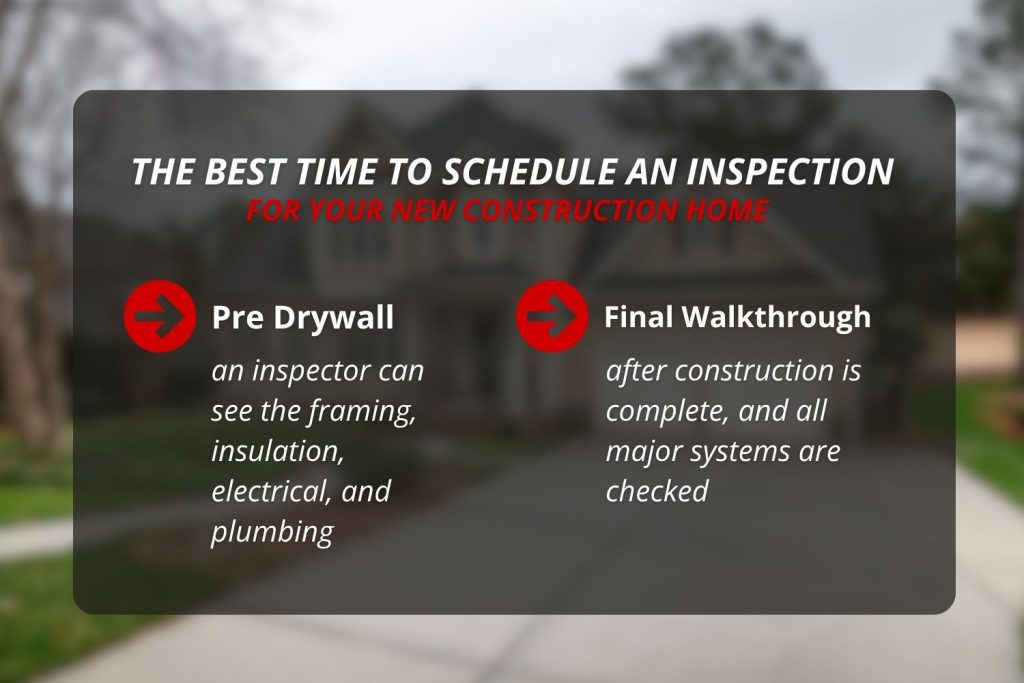
If your builder allows it, scheduling inspections at two points during construction produces the best results:
The pre-drywall inspection is the most valuable. With walls open, an inspector can see the framing, insulation, electrical rough-in, and plumbing rough-in before they are permanently enclosed. Defects found at this stage are straightforward to correct. Defects found after drywall installation require opening walls.
The final walk inspection happens after construction is complete and before closing. This is what most buyers are familiar with. A thorough inspector checks every major system, all fixtures, the roof, the foundation, the exterior grading and drainage, and all builder-installed finishes.
Related Questions to Explore
- Do I need an inspection on a new construction home in Georgia? You are not legally required to get one, but it is strongly advisable. New construction homes regularly have defects that pass municipal inspection and builder walk-throughs. An independent inspector works exclusively in your interest and produces a written report documenting any issues for builder warranty claims.
- What areas of Georgia have the most new home construction? The Atlanta metropolitan area has the highest concentration of new construction, with over 900 active communities. High-growth suburbs, including Alpharetta, Milton, Cumming, Suwanee, and Johns Creek in the north, and Douglasville and Newnan in the west, are particularly active. Savannah and its surrounding coastal communities are also seeing sustained growth.
- What is included in a new construction home warranty in Georgia? Builder warranties in Georgia typically follow a tiered structure: one year for workmanship defects, two years for mechanical systems (HVAC, plumbing, electrical), and ten years for structural defects. Reading your specific warranty document carefully and noting the claim procedures is essential before closing.
- Should I get an independent home inspection for a brand-new home? Absolutely. In Georgia’s rapidly growing real estate market, builders are working at lightning speed to keep up with demand, which naturally increases the risk of oversights. Don’t fall into the trap of assuming “brand new” means “flawless.” Hiring your own independent home inspector gives you a dedicated advocate to catch critical issues before they get buried behind drywall.
Protect Your New Home Investment With an Inspection
New homes in Georgia represent a significant investment. An independent pre-closing inspection is one of the most cost-effective steps you can take to ensure that the investment starts on the right foot.
Harmony Home Inspection Services provides new construction inspections across Georgia, including pre-drywall and final walk-through inspections. Our inspectors are trained to evaluate systems and structures at every stage of the building process, and our reports are detailed enough to support builder warranty claims.
Conclusion
The U.S. Department of Housing and Urban Development recommends that all homebuyers, including those purchasing new construction, conduct a thorough home inspection as part of the closing process. If you are in the process of purchasing a new home in Georgia, visit our services page or call to schedule an inspection before your closing date.